Python List Comprehension Stackoverflow
Python List Comprehension Stackoverflow. But here, you can't, because there's no way to put a try/except into an expression. List(mit.take(n, mit.padnone(a))) # [1, none, none, none, none] if you wish to replace the default none padding, use a list comprehension:
As stated in the docs: Ok, so i should stick to your 2nd proposal then, because this makes up the central part of my code. To understand, we will take a simple example from nlp.
# This Is A Numpy Floating Array
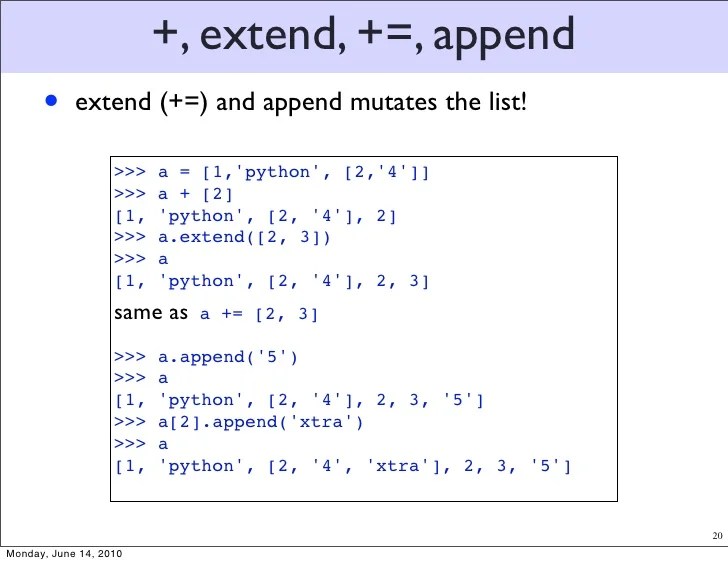
This syntax was introduced in python 3 and backported as far as python 2.7, so you should be able to use it regardless of which version of python you have installed. But here, you can't, because there's no way to put a try/except into an expression. 1 this is a design principle for all mutable data structures in python.
Pycharm 2021.3 (Community Edition) Windows 10.
Another thing you might notice is that not all data can be sorted or compared. @cards i don't think it is. This is just a very verbose version of the main.
I'd Be Interested To Know If Others Can Replicate These Timings.
The advantage of this approach over a loop or list comprehension is that you can go back as many times as you want. As stated in the docs: Jul 5, 2010 at 11:37.
You Can Use Numpy To Convert A List Directly To A Floating Array Or Matrix.
Adding the list() call around the iterator made by reversed(l) must add. Import pandas as pd # read the csv into a pandas data frame (df) # with a df you can do many things # most important: Most straightforward way is to use a comprehension by iterating over list_of_keys.
Import Numpy As Np List_Ex = [1, 0] # This A List List_Int = Np.array(List_Ex) # This Is A Numpy Integer Array If You Want To Convert The Integer Array To A Floating Array Then Add 0.
Easily modified for whatever, the int at the end is the number of days in the past you want. Here's a one liner for bash scripts to get a list of weekdays, this is python 3. Result = [] [ result.extend(el) for el in x] for el in result:


Comments
Post a Comment